
The creator economy isn't a content story — it's a capital structure story. It's about who owns distribution, who captures monetization, and who controls narrative. Most of the industry hasn't figured that out yet. A university-based center is uniquely positioned to.
I've spent my career inside an industry that didn't have a name yet — building brands, advising platforms, structuring new things from scratch. What follows isn't a resume. It's a record.
The creator economy is growing at 15% compound annual growth and is projected to represent 25% of the global media market by 2030. This isn't a trend. It's a structural shift — and no university has built the institution to match it yet.
We are living through an era of low trust. Trust in media, in institutions, in expertise — it's eroding across the board. In that environment, Syracuse stands out. It carries credibility, legacy, and value that most institutions spend generations trying to build.
Newhouse is one of the country's most respected communications and journalism schools. Whitman is building toward its 2030 vision — defined by entrepreneurship, innovation, and real-world impact. Together they represent something no other university has: a natural home for the creator economy at the intersection of media literacy and business intelligence.
The CEC doesn't have to manufacture credibility. The brand provides it on day one. Syracuse alumni are in every room that matters — media, tech, entertainment, venture. When the CEC speaks, it speaks with institutional weight that most new centers spend decades trying to earn.
That's the starting asset. In a world where trust is the scarcest resource, Syracuse already has it. The question is whether the leadership can convert that brand equity into institutional authority — and build something the industry depends on. I've done that before. The mechanics are the same. The stakes are higher.
The CEC isn't a cost center. It's a flywheel. Research produces credibility. Credibility attracts industry engagement. Industry engagement funds convenings. Convenings build audience and visibility. Visibility attracts sponsors and naming rights. Sponsorship funds the next research cycle. It compounds.
The key is starting with research rigorous enough that the industry has to pay attention. Right now, the most insightful structural analysis of the creator economy is coming from investment firms — IPR.VC, Spotter, Goldman Sachs. Not universities. Their work is strong, but it serves their portfolios. The CEC can produce what they can't: independent, interdisciplinary analysis with no financial conflict of interest.
Newhouse's communications methodology plus Whitman's business and entrepreneurship lens is the exact combination this research requires. That's not an accident — it's the architecture of the flywheel's first turn.
The most important operating principle for the CEC: it should run like the institutions it studies. The creator economy's most durable businesses don't wait for a distribution deal or a grant cycle. They build audience, generate IP, earn attention, and monetize across multiple streams simultaneously.
AfroTech didn't become a 40,000-person conference by waiting on a budget line. It got there because Blavity understood audience development, sponsorship architecture, and convening power as one integrated system — not three separate functions.
The CEC can operate the same way. Build an audience through research and programming. Generate IP through white papers, frameworks, and certifications. Earn naming rights and sponsorship through a convening brand — CUSE Creator Con — that the industry wants to be associated with.
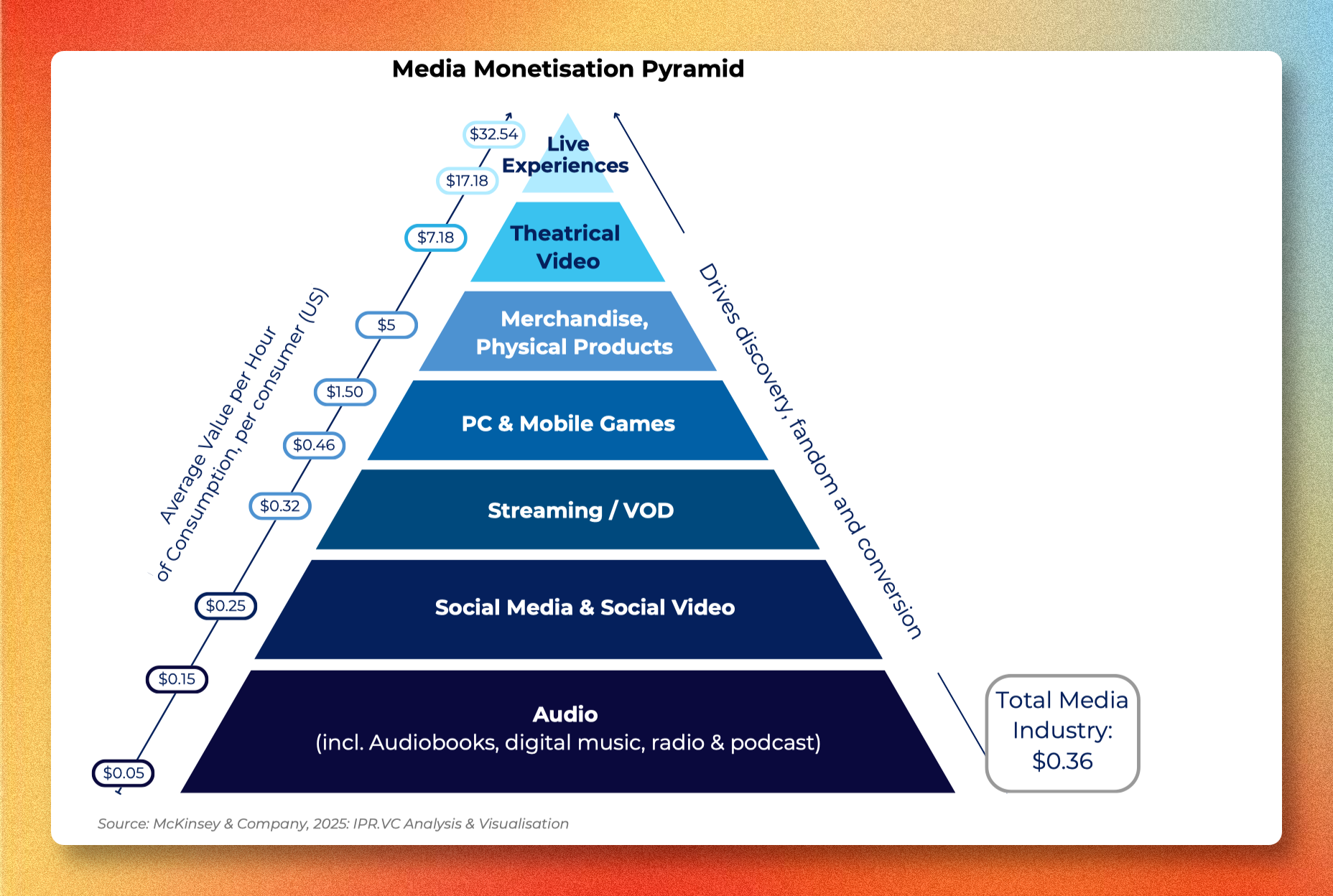
Spotter's data shows live experiences generate $32.54 in revenue per user per hour — 130x the value of social media. The CEC's physical convenings aren't events. They're the highest-value asset in the portfolio.
A center that depends entirely on university funding and grants has a ceiling. The CEC should be built for financial sustainability from day one — and the architecture is already visible.
Naming rights. The right partner pays to have their name on the most important creator economy institution in higher education. That's not a donation. That's a brand investment with measurable ROI.
Executive education. Brands, platforms, agencies, and venture funds all need to understand where the creator economy is heading. The CEC delivers that through short-format professional development. IPR.VC notes that creator economy capital structures now require investors to "rethink how capital participates in the industry." That's curriculum — and it's curriculum people will pay for.
Event sponsorship. CUSE Creator Con is the annual apex, but the sponsorship calendar runs year-round: roundtables, lectures, workshops, industry convenings.
IP licensing. The frameworks, certifications, and research reports the CEC produces have commercial value beyond Syracuse. License them.
My network runs deep across venture, brand, and platform — the exact ecosystem the CEC needs to activate each of these streams. These aren't hypothetical relationships. They're active ones.
Most institutions treat media as communications — a press release, a social post, a newsletter. The CEC should treat it as infrastructure.
Media is how the flywheel accelerates. Research published as a report gets 200 downloads. The same research packaged as a compelling media piece — a podcast analysis, a video essay, a data-driven editorial — reaches 200,000. The insight is identical. The distribution changes everything.
This is the creator economy's core lesson applied back to the institution studying it: distribution determines value capture. The CEC needs its own distribution channels, its own content voice, its own media presence. Not to become a media company — but to ensure the research, frameworks, and ideas it produces reach the people who need them.
IPR.VC maps the new value chain clearly: it starts with attention and audience engagement, then distribution, then IP value. The same logic applies to institutional knowledge. Build the audience first. The value follows.
A deep network across venture, brand, and platform means the CEC's media doesn't just reach an academic audience. It reaches the rooms where decisions get made.
The creator economy is the fastest-growing sector in media and business — and it has no professional infrastructure. No certifications. No standards. No institutional authority that isn't also trying to sell something.
Cybersecurity has CompTIA. Finance has the CFA. Law has the bar. A 22-year-old trying to build a sustainable creator business has YouTube tutorials and vibes.
IPR.VC and Spotter are producing the sector's most rigorous analysis — but they're investment firms. Their research serves their portfolios. The CEC's research serves the field. That distinction is everything.
Syracuse is positioned to write the first draft of what professional means in this space. The anatomy of a sustainable creator business. Frameworks for evaluating platform risk. Standards for what constitutes rigorous creator economy research. Certifications that signal to a brand or investor: this person understands the economics, not just the content.
That's not a program. That's a legacy. And it's the thing only a university can build — because only a university has the independence, the interdisciplinary capability, and the credibility to make it stick.
Whitman's 2030 vision is built around entrepreneurship and innovation. Newhouse's mission is media and communication excellence. The CEC at their intersection is where the next era of both gets defined. That's what I'm here to build.
The kind of person you're recruiting needs to have instincts — and the capacity to show that. Due Dilly is a show I host with my best friend Carl. We go deep with people who are building things in distinct places. It's not a media industry podcast. It's a show about what it actually takes to make something real.
The Center for the Creator Economy cannot depend on tuition revenue and goodwill alone. For the impact to compound, the institution must be financially engineered to endure. The good news: the Center's unique position — sitting at the intersection of media, capital, and talent — makes it one of the most sponsorable academic properties in the country. The opportunities are open now.
Buildings, endowed chairs, and named programs are among the highest-ROI sponsorship vehicles in higher ed. The CEC's national reach and media profile make it a premium naming opportunity — one that grows in value as the center grows in stature.
A two-way bridge. Industries that don't understand the creator economy lose deals, talent, and relevance. Practitioners who want professional legitimacy need frameworks and credentials. CEC is where both sides get what they need.
Platforms, tools, and media companies pay for structured access to the next generation of creators. The CEC's pipeline isn't just talent — it's audience, research, and brand association with the institutional credibility they can't manufacture themselves.
Properly structured events are self-funding and create deal flow that sponsors pay to access. The CEC can build a portfolio of annual events across different audiences — brands, investors, practitioners, students.
Curriculum, research, and frameworks built at Syracuse have commercial value far beyond Syracuse. Licensing creates non-dilutive, scalable revenue from assets the CEC already had to build to do its core job.
The CEC sits inside one of the densest deal-flow networks in the creator economy. Structured correctly, that network becomes a revenue stream — not just a relationship benefit. Capital wants access. Access has value.
How they compound
These are people who can speak directly to my capacity, skills, leadership, and executional abilities — not as observers, but as people who have worked alongside me or watched me build.

Jessica can speak to how I show up in rooms that matter — as a builder, a connector, and someone who takes institution-making seriously. We've moved in overlapping circles long enough for her to speak to both my character and how I lead.

Paul can speak to my thinking at the institutional level — how I approach research, policy adjacency, and building things designed to last. He understands the difference between someone who talks about systems and someone who builds them.

Kendra can speak to how I understand audiences — not just as demographics, but as people with real needs and behaviors. She's seen how I think about consumer insight, creator relationships, and what it actually takes to build products and platforms people trust.

Maya can speak directly to how I operated inside LinkedIn — how I thought about content, creator relationships, and audience engagement at scale. She watched me work and can speak to both the quality of my thinking and how I show up as a collaborator.

Adria can speak to how I engage with institutional frameworks — as a Ford Fellow, she saw how I think, how I listen, and how I operate when the work is serious and the stakes are real.
Aaron co-founded Blavity Inc. with me. He watched me build from the inside — the decisions, the pressure, the tradeoffs. There is no closer vantage point than that. He can speak to how I lead when it's hard, not just when it's easy.
This is how I built the site, and everything I used. Step-by-step guide →
I was invited to speak at TEDx Syracuse University — on stage, on this campus — before this role existed, before this application was written. The relationship with Syracuse isn't something I'm constructing. It's already there.
I've been inside every era of the evolution of this industry before it had a name — in industry, as a founder, a creator, and inside institutions. If you've seen enough, reach out.